
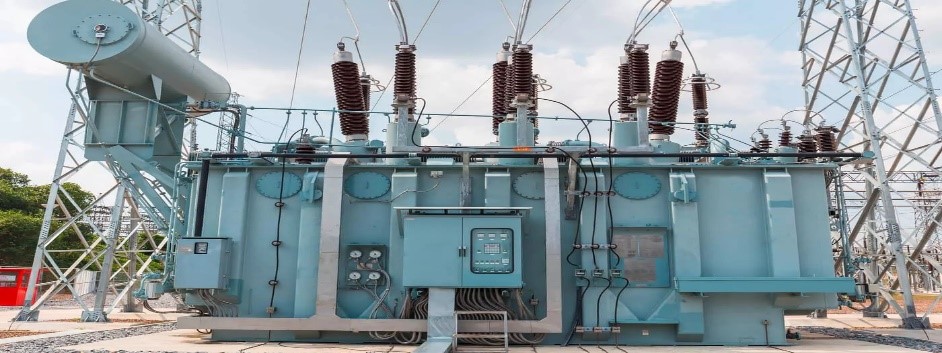
The increase in demand for energy has made us enhance the power transformation capacity as well as reactive power compensation requirement. Reliability and availability of important assets play an important role in the smooth operation of a power system. The transformers are vital and expensive assets in a power system hence it is important to maintain the health and efficiency of the power transformer for maintaining the reliability of the system.
To match the speed of rapid development happening across the globe, quality solutions are required in the power sector too. Transformers being important in this, the Transformation ratio has also gained equal importance. It not only ensures quality through Stability and Safety but also ensures revenue generation.
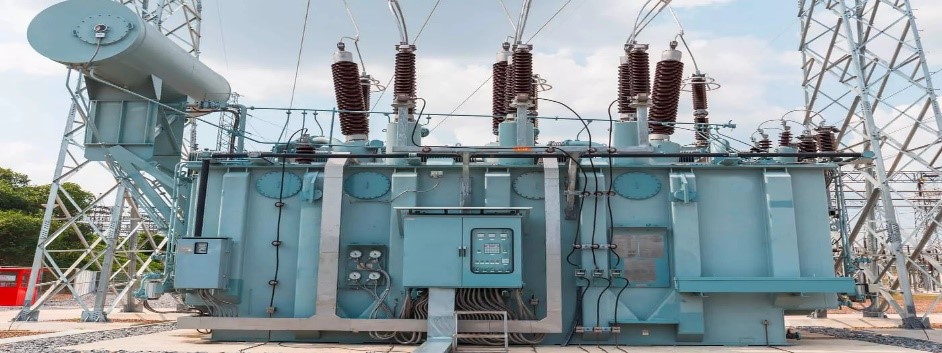
Transformers – Type of faults and causes of failure
The function of the transformer is to step up or step down the system voltage without changing the frequency. The transformers are divided into two categories power transformer and distribution transformer. In transmission networks, power transformers are used to transmit power over long distances whereas distribution transformers are step-down transformers installed at the user end to step down the voltage to the desired level suitable as per application. Generator Transformers (GTs) are installed at the generator end or the power plant which step up the voltage at a high level like 400KV etc. which was generated at 11 or 33KV level.
If any transformer undergoes a failure due to electrical or thermal stresses or faults etc. will cause high power loss and ultimately revenue loss. The main parameters causing the failure of the transformer are electrical disturbance, insulation deterioration, inadequate maintenance, loose connections, lightning and moisture. If we consider location-wise faults in the transformer we find that coils, windings and insulation undergo a maximum number of faults. Hence it is important to check the healthiness of the transformer, it is important to regularly conduct the testing of transformer winding and insulation.
Need for transformer turns ratio measurement
Turns ratio measurement is an important test conducted on the transformer during both routine testing and factory acceptance tests. For conducting the transformer turns ratio test we apply a suitable low voltage to the primary side of the transformer and the voltage generated at the secondary of the transformer is measured. The ratio between these two voltages is called the voltage ratio of the transformer. From the values of the voltage ratio, we can find out the turns ratio and vice-versa. The following Table 1 indicates the relation of turn ratio and voltage ratio values for the transformers in different winding configurations.
| Transformer | Turns ratio |
| Single phase | = Voltage Ratio |
| Star – Star | = Voltage Ratio |
| Star – Delta | = Voltage Ratio / √3 |
| Delta – Star | = Voltage Ratio * √3 |
| Delta – Delta | = Voltage Ratio |
The following are the main reasons to conduct the transformer turns ratio test
- With the help of the transformer turns ratio test we can verify the ratio of the primary winding of the transformer to the secondary specified by the transformer OEM
- The quality of manufacturing processes can also be verified by using the turns ratio test
- Transformer voltage balance is also an important thing which we can verify by using the TTRM test. i.e. all the three phases should have the same turns ratio
- Conditions like overheating and overcurrent can also be found by conducting the TTRM test
The ratio test results should be verified with the factory test reports. The ratio should be within 0.5% of factory test results in case the power transformer is working for a long time. In the case of a new transformer, the ratio error limit is 0.1 % that of the factory test results. If we observe the higher deviation of ratio from the expected value, then it may indicate that there is a manufacturing defect in the winding like improper turns, incorrect polarity or incorrect winding configuration. There is a possibility of insulation failure also, between inter-turn winding or winding to ground. Defects in tap changers like incorrect assembly of winding connections, high resistance connections or incorrect tap changer settings can also cause higher ratio errors from the expected value of the TTRM test.
Excitation current test and its importance
The excitation current is a diagnostic tool used to identify a failure in a power transformer. The excitation current is useful for calculating the no-load loss of the transformer. It is the current which flows in the primary of the transformer winding due to the applied voltage and is responsible for establishing the magnetic flux in the transformer core. The excitation current is also known as the magnetizing current. It creates a magnetic field in the transformer to induce a voltage in the secondary winding.
The magnetizing current of the transformer can be about 1 to 5 % of the full load current of the transformer. There may be similar readings on the two outer phases of transformers and lower readings on the central phase. The observed results within the 30% of the previous test results are considered to be satisfactory
Excitation current details can be used to analyse shorted turns and open turns in the transformer winding, to identify the core shifting or winding shifting following are the predicts one can draw from the magnetizing current results:
- HV Winding SHORT – If the excitation current value obtained is in multiples of tens of factory test results observed on the same test voltage, then there is the possibility of shorted HV winding
- HV winding OPEN – If the excitation current is near zero due to an open path in the circulation of the excitation current, then we can say that HV winding is open
- LV winding OPEN – In the case of open-circuited LV winding we get the normal results of excitation current same as the factory test report but the LV winding voltage will be unstable hence we may get an incorrect ratio value.
The magnetizing current test and ratio test of the transformer are AC tests hence it is advised that these tests should be conducted before the DC tests like winding resistance test or insulation resistance test. Otherwise, transformer winding will get charged and core will get magnetized due to the DC supply and it will affect on the results of the AC tests.
Magnetic Balance Test
The magnetic balance test is a commonly used test to verify if there is any imbalance in the magnetic circuit of the transformer. This test is not specified by national or international standards of the power transformer but it is widely used to check the magnetic circuit of the transformer. With this test, the informality of flux distribution in the three-phase transformer core is also verified. Also, with this test one can identify inter-turn faults in the transformer at the early stage of manufacturing work.
Conclusion
In this blog we covered the applications and importance of transformer turns ratio test along with magnetizing current and magnetic balance test. Advanced transformer turns ratio meter should have the facility to conduct the all tap ratio test along with ratio error, magnetizing current, magnetic balance vector group detection and phase angle deviation test. SCOPE has carried out a long study and research and come up with TTRM series – Single phase and three phase transformer turns ratio measurement kits. For Information related to TTRM Solutions offered by SCOPE you may visit – https://scopetnm.com/test-and-measurements/transformer-testing-equipment/transformer-turns-ratio-meter/ttrm-302
For more information about the subject and advanced transformer turns ratio meter inquiry please write to us at marketing@scopetnm.com
 SCOPE Corporate Blog
Nice valuable information indeed for Utility Engineers and PG /PhD Scholars pursuing research in thematic area.
regards
LikeLike